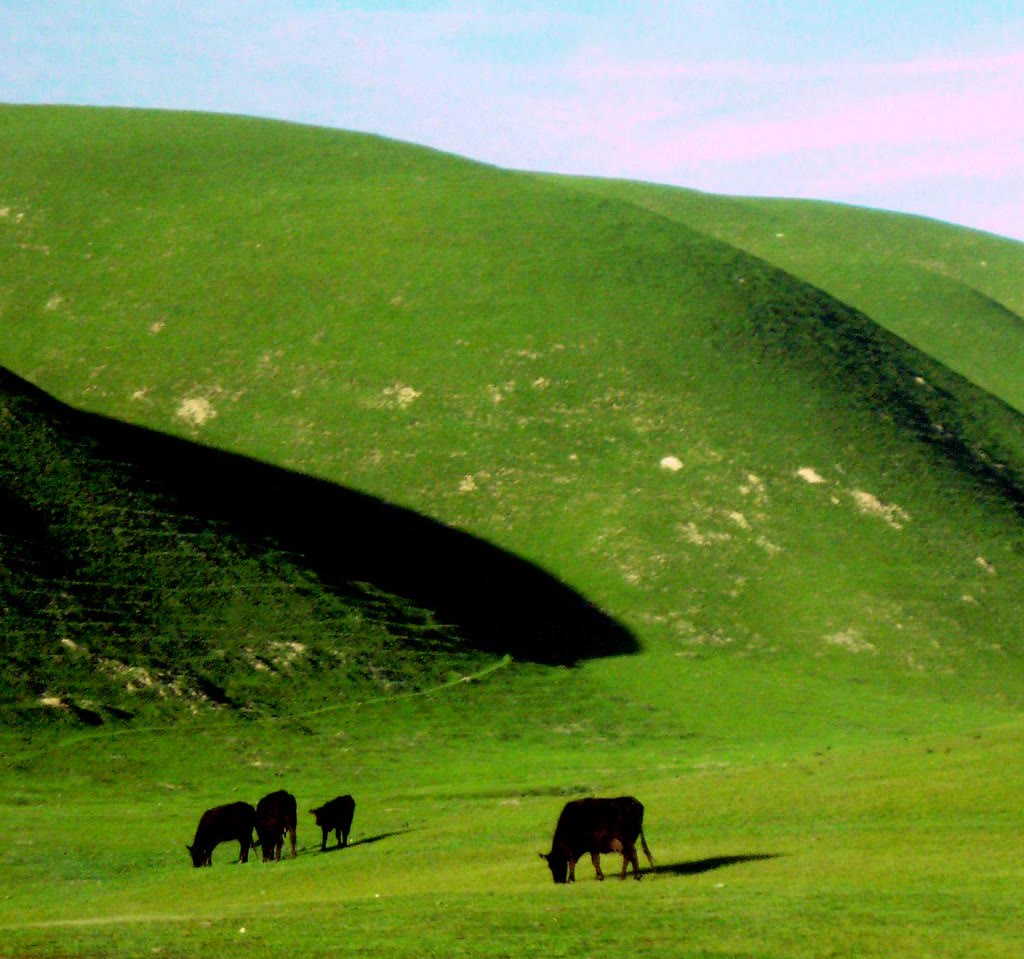
Walk down the tallow aisle of the internet and you will notice that almost every jar says the same two words before it says anything else: grass fed. It has become the default credential of the category, the thing brands lead with before texture, scent or price. The question worth asking is whether it is a real compositional claim or a comfortable one.
The short answer: the compositional differences are real and reasonably well documented in the nutrition literature. Whether those differences change anything measurable on your face is a separate question, and one nobody has answered yet. Both halves of that sentence deserve equal weight.
What actually changes when cattle eat grass
Cattle build their fat partly from what they eat, so the finishing diet shows up in the lipid profile. The most cited synthesis is a 2010 review in Nutrition Journal by Daley and colleagues, which pooled three decades of comparisons between pasture-finished and grain-finished beef.
Its findings are consistent across studies. Grass-finished beef carries meaningfully more conjugated linoleic acid (CLA) — commonly two to three times more, and higher in some datasets — along with more trans-vaccenic acid, the precursor the body converts to CLA. It also carries more omega-3 alpha-linolenic acid and a narrower omega-6 to omega-3 ratio. Total saturated fat is broadly similar between the two systems, but the mix inside that total shifts: proportionally more stearic acid, proportionally less myristic and palmitic.
The antioxidant picture moves too. Daley's review reports roughly three times more alpha-tocopherol (vitamin E) in grass-finished beef, and anywhere from 1.5 to 10 times more beta-carotene, which is why grass-finished carcass fat often looks faintly yellow rather than chalk white.
A frequently quoted lab analysis commissioned by the Weston A. Price Foundation compared rendered grass-fed and grain-fed tallow directly and found a similar direction of travel — several times more alpha-linolenic acid, substantially less linoleic acid, and more oleic acid in the grass-fed sample. Worth flagging: that is a single commissioned analysis from an advocacy organisation, not peer-reviewed work, so treat it as consistent with the literature rather than as proof.
The honest gap nobody advertises
Here is what none of the above establishes. Every study named so far measured beef, or measured fat in a laboratory. None of them measured skin.
There are no human trials comparing grass-fed tallow against grain-fed tallow on skin — not for hydration, not for barrier repair, not for irritation. Nobody has run that head-to-head. Anyone telling you grass-fed tallow performs better on skin is extrapolating from nutrition data, which is a reasonable hypothesis and not a finding.
The broader evidence base is thin as well. A 2024 scoping review in Cureus looked at tallow's biocompatibility with skin and found 19 studies meeting its criteria. Its conclusion was cautious: tallow appears broadly compatible with healthy skin and may offer hydration benefits, but the available data were limited and at times contradictory, and the authors called for more rigorous clinical research. That is the honest state of play for tallow generally, before you even get to the grass-fed sub-question.
So why does the industry lead with it? Partly because it is a genuine, verifiable supply-chain fact in a category full of unverifiable ones. Partly because it signals a whole set of adjacent values — pasture, small herds, minimal intervention — faster than a paragraph could. And partly, plainly, because it works as marketing. Those are three different reasons and only the first is about the fat.
Rendering and purity matter at least as much
There is a second variable that gets far less airtime than the animal's diet, and it may matter more: what happens after the fat leaves the animal.
Rendering is a heat process, and unsaturated fats are the ones that oxidise. The very fatty acids that make grass-fed tallow interesting — the alpha-linolenic acid, the CLA — are also the most fragile ones in the jar. Hard, hot, prolonged rendering degrades them; so does long storage in warmth or light. A grass-fed tallow rendered badly can end up nutritionally less interesting than a carefully rendered grain-fed one, and it is more likely to smell like it.
Purity is the other half. Tallow can be rendered from leaf fat (the suet around the kidneys) or from mixed trimmings and scrap, and the two behave differently in scent, colour and consistency. Filtration determines how much protein residue is left behind, which affects both smell and shelf life. None of this appears on a front label, and none of it is captured by the words "grass fed" — which is precisely why the phrase should be read as one input among several rather than a quality summary.
What "grass-fed and grass-finished" means here
The distinction between fed and finished exists because in some markets cattle can graze pasture for most of their lives and then spend a final period in a feedlot on grain, which is when the fat profile shifts most. "Grass-fed" alone does not always exclude that. "Grass-finished" says the animal was never grain-finished.
Australia has been unusually tidy about this. The Pasturefed Cattle Assurance System (PCAS), developed by the former Cattle Council of Australia and administered through AUS-MEAT, set a lifetime standard: cattle must never have been fed separated grain or grain by-products, and must have had continuous access to graze, with a diet of grass, forbs, browse or cereal crops in the vegetative pre-grain state, milk before weaning aside. Optional modules covered antibiotic-free and HGP-free claims. The PCAS program itself stopped operating on 1 January 2026, but its standards remain the baseline for grassfed claims under Australia's Animal Raised Claims Framework.
The practical upshot for a buyer: in an Australian or New Zealand supply chain, a lifetime-pasture claim is a fairly meaningful one, because the underlying standard was written to mean fed and finished. Ask a brand which system its supplier sits under, and whether the tallow is leaf fat. Those two questions will tell you more than the words on the front.
One last thing, because this is a sunscreen publication. Tallow — grass-fed, grass-finished, leaf-rendered or otherwise — provides no UV protection whatsoever. It is a fat. Nothing about the feeding regime changes that.
Sources
- Nutrition Journal — A review of fatty acid profiles and antioxidant content in grass-fed and grain-fed beef
- PubMed — A review of fatty acid profiles and antioxidant content in grass-fed and grain-fed beef (Daley et al., 2010)
- Cureus — Tallow, Rendered Animal Fat, and Its Biocompatibility With Skin: A Scoping Review
- Weston A. Price Foundation — Fatty Acid Analysis of Grass-fed and Grain-fed Beef Tallow
- AUS-MEAT — Pasturefed Cattle Assurance System (PCAS) information
- Beef Central — Sun sets on PCAS pasturefed cattle assurance era
- Meat & Livestock Australia — Going grassfed 101