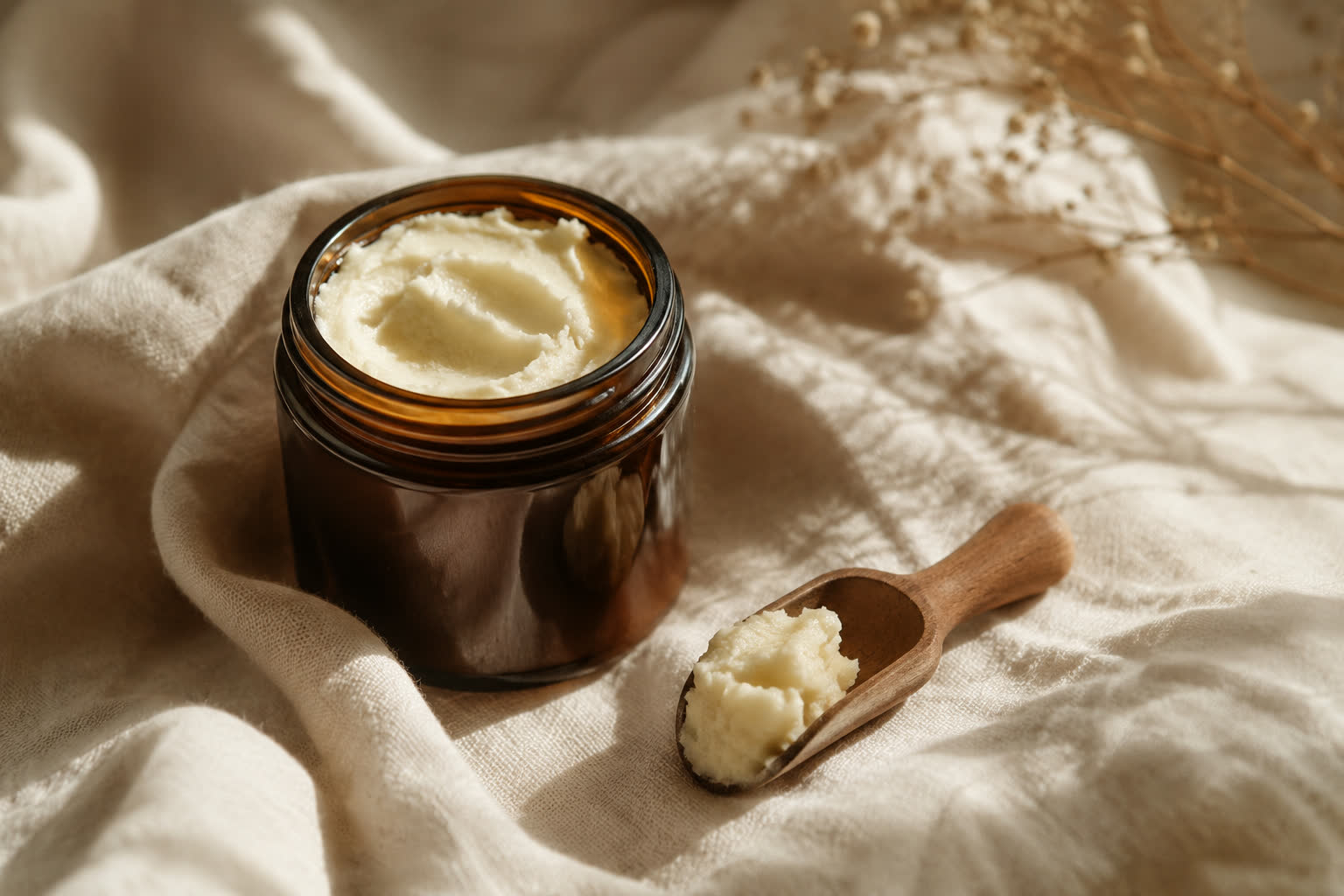
Search for the "best tallow balm" and you will get lists. What you will rarely get is a method — a way of picking up any jar, in any shop, and working out whether it is worth your money.
This guide names no products. It is a set of criteria you can apply yourself, because the tallow category is young, fast-moving and lightly policed at the marketing end, which means the label is doing more work than usual.
One honesty flag first. The clinical evidence for rendered beef fat as a skincare ingredient is thin. A 2025 analysis in the Journal of Cosmetic Dermatology found that tallow claims about acne, atopic dermatitis and psoriasis were common on social media but largely unsupported by cited evidence, with most posts coming from people without health credentials. Tallow does share fatty acids with human sebum — palmitic and oleic acid feature in both — so there is a plausible barrier-support story. But plausible is not proven. Choose accordingly: as an emollient that may suit your skin, not as a treatment.
Start with the ingredient list
Turn the jar over. Ingredients are listed by concentration, highest first, so the first name tells you what you are mostly buying.
If tallow is not first, or second at most, you are buying a balm that happens to contain tallow. That is not automatically bad — blends with olive or jojoba oil are common and often more spreadable — but it changes the value equation, especially if the price is pitched on tallow being the hero.
Length matters too, though not the way "clean beauty" marketing suggests. Short lists are not morally superior; they are easier to assess. A well-made balm typically runs to between three and eight ingredients: tallow, perhaps a carrier oil, perhaps beeswax for structure, an antioxidant, a scent component. If the list runs longer, you should be able to work out what each addition does. If you cannot, ask the maker.
Two specific things to look for. First, standardised ingredient naming (tallow usually appears as Bos taurus tallow, with botanical-style names for the oils around it). A label written entirely in marketing English — "nourishing ancestral fat blend" — has not been through a compliance check. Second, an antioxidant such as tocopherol (vitamin E) or rosemary extract, which suggests the maker has thought about the product going rancid.
"Grass-fed" is a claim, not a certification
Almost every tallow balm on the market says grass-fed. Very few explain what stands behind the phrase.
In Australia, grassfed claims for beef have been underwritten by the Pasturefed Cattle Assurance System, an AUS-MEAT-administered standard covering lifetime traceability, no confinement for intensive feeding, and a pasture-only diet. The PCAS program ceased operating on 1 January 2026, but its standards remain the baseline for grassfed claims under the industry's Animal Raised Claims Framework. The point for a shopper is that a verified claim traces back to something like this — a standard, an auditor, a chain of custody — while an unverified one traces back to a marketing meeting.
So the question to put to a maker is not "is it grass-fed?" It is: where does your tallow come from, and how do you know? Useful answers name a country or region, an abattoir or supplier, and ideally a certification or assurance scheme. Vague answers — "premium sourced", "ethically raised" — tell you nothing verifiable.
Worth separating, too: where the fat came from and where the balm was made. A product can accurately be made in Australia from imported tallow. Neither is a problem; conflating them is.
Scent, preservatives and packaging: the practical risks
Fragrance is the most common source of trouble in balms, and essential oils are fragrance. Dermatology sources are clear on why. Limonene and linalool — terpenes present in the overwhelming majority of essential oils, particularly citrus and lavender — oxidise on contact with air into hydroperoxides that are far more potent sensitisers than the parent compounds. DermNet describes this directly; reviews in Contact Dermatitis argue the hydroperoxides are significant enough allergens to warrant routine patch testing. Allergic contact dermatitis to fragrance affects a low single-digit percentage of the general population, so this is a minority risk, not a reason for alarm — but if you have reactive skin, eczema or a history of fragrance allergy, an unscented balm is the lower-risk choice, and any new product is worth trialling on a small patch of skin first.
Preservation works differently in balms than in creams. A pure oil-and-fat balm contains no water, so it does not need a broad-spectrum preservative under normal conditions. That protection disappears the moment water gets in — wet fingers, a steamy bathroom shelf, an open jar by the shower. Formulation educators are consistent that an anhydrous product likely to meet water should either be kept scrupulously dry or contain a preservative. This is the strongest argument for tubes, sticks and pump packaging over wide-mouth jars: they keep fingers, and the microbes on them, out of the product.
Antioxidants are a separate issue. They slow rancidity but do not stop microbial growth. So ask two things: what is the shelf life from manufacture, and is there a batch or best-before date on the jar? Tallow that has turned smells unmistakably off, like old cooking fat.
Price per gram, and the claims that should stop you
Compare on price per gram, not per jar. Divide price by net weight and the spread across the category turns out to be wide, and often unrelated to what is inside. Small tins are especially misleading — a 30g tin at the price of a 100g jar is a threefold premium you may not have noticed. Balms are also dense and go a long way, so a jar tends to outlast a bottle of lotion.
Then the red flags. Any SPF number on a tallow balm should stop the transaction. In Australia, sunscreens are therapeutic goods regulated by the TGA, tested and labelled to the Australian and New Zealand standard, and a product making a real SPF claim has been through that process. A moisturiser cannot simply assert sun protection.
The same logic applies to health claims. As the TGA and AICIS both set out, saying a product heals eczema, treats acne or otherwise prevents or cures a condition makes it a therapeutic good, which requires entry on the Australian Register of Therapeutic Goods — AICIS lists "heals eczema" as a textbook example. A balm advertising cures is telling you either that it is regulated, in which case it will say so, or that its maker has not checked the rules. Neither inspires confidence in the rest of the label.
Sources
- Journal of Cosmetic Dermatology — Beef Tallow-Based Skincare Claims in Social Media: A Cross-Sectional Analysis
- Cleveland Clinic — Is Beef Tallow Good for Your Skin?
- National Geographic — Beef tallow as skin care? Experts explain what's truth and myth
- DermNet — Contact allergy to hydroperoxides of limonene and linalool
- Contact Dermatitis — Limonene and linalool hydroperoxides review: pros and cons for routine patch testing
- AUS-MEAT — Pasturefed Cattle Assurance System (PCAS)
- Cattle Australia — Product Integrity
- School of Natural Skincare — Preservatives in solid beauty bars: do you need them?
- Formula Botanica — Natural preservatives for cosmetics
- AICIS — Cosmetics and therapeutics
- Therapeutic Goods Administration — Determining if your product is a cosmetic or therapeutic good
- Therapeutic Goods Administration — Sunscreen regulation in Australia