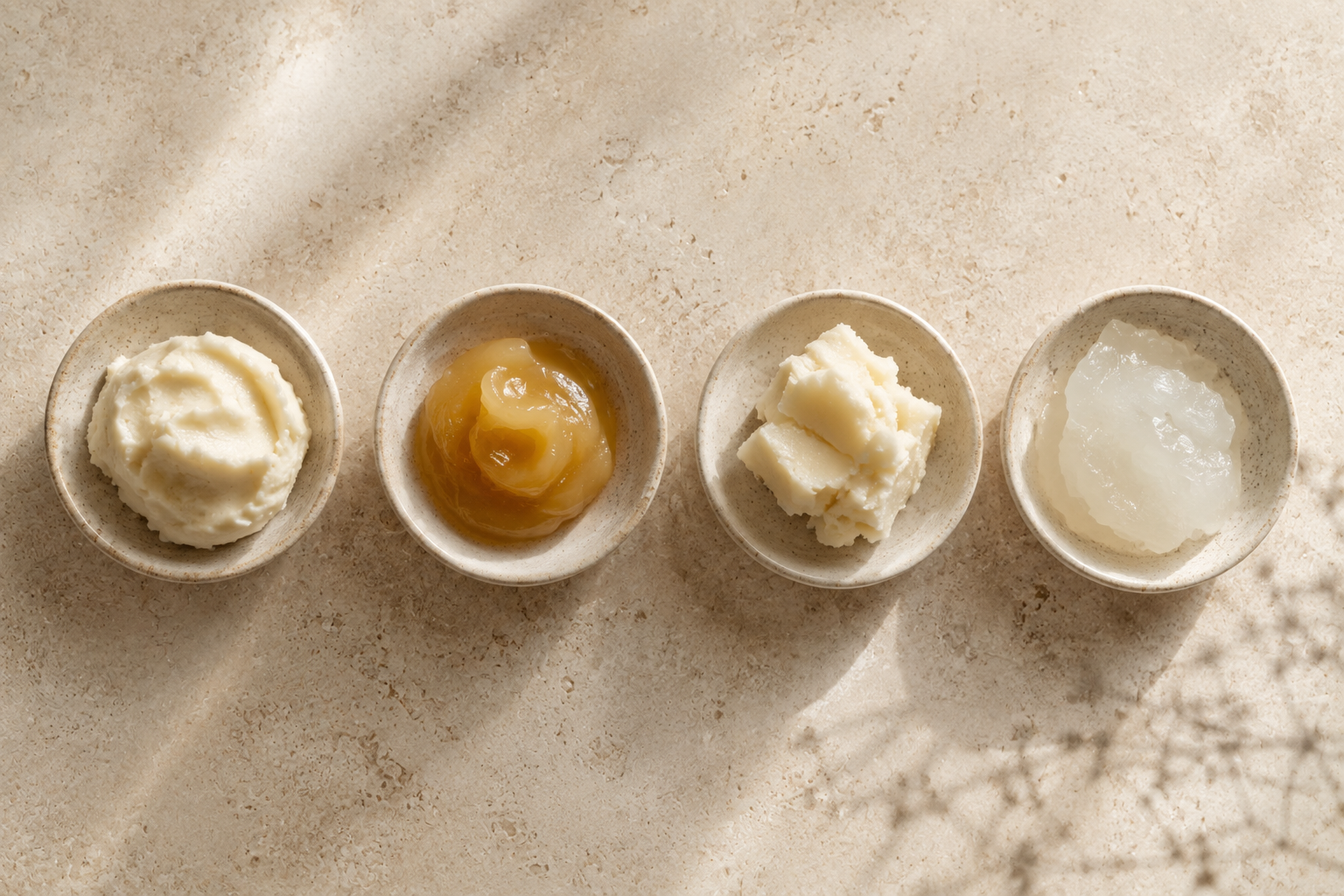
Most of the argument about moisturisers comes down to four ingredients. Tallow, shea butter, lanolin and petrolatum all do a version of the same job — slow the water leaving your skin and leave a softer surface behind — and each has a constituency convinced the other three are a mistake. They are not interchangeable, but the differences between them are smaller and stranger than the marketing suggests.
Here is a fair comparison, with the evidence gaps marked where they fall.
What each one actually is
Petrolatum is a purified semi-solid blend of hydrocarbons refined from petroleum. It contains no fatty acids, no esters and nothing biologically active. That inertness is the whole point of it.
Tallow is rendered ruminant fat, overwhelmingly triglycerides, dominated by oleic, palmitic and stearic acids. Its most repeated selling point is that this profile broadly resembles human sebum — a comparison the 2024 Cureus scoping review on tallow does note, though "resembles" is doing a lot of work in a claim that gets stretched hard on social media.
Lanolin is the wax secreted by sheep's sebaceous glands, recovered from shorn wool. Structurally it is not a triglyceride at all but a complex mix of wax esters and sterols, which is why it behaves so differently — grabbier, waxier, and unusually good at holding water within itself.
Shea butter is pressed from the nuts of the West African shea tree. Mostly oleic and stearic acids, but its distinguishing feature is a large unsaponifiable fraction — triterpenes and other minor compounds present at levels far above most plant butters.
Feel, occlusion and the strength of the evidence
On raw occlusion, this is not a close contest. Petrolatum is the reference standard against which every other occlusive is measured, reported to reduce transepidermal water loss by up to 99%, and by more than 98% even at around 5% concentration in a formula. Nothing on this list matches that, and it is worth saying plainly rather than burying: petrolatum is also by a wide margin the best-studied of the four, with decades of dermatological use behind it.
The others sit lower and are harder to rank against each other, because comparative data are patchy. A 2022 study in the Journal of Cosmetic Dermatology set out to benchmark plant-derived emollients against petrolatum for occlusive performance precisely because the field lacks that comparison. Tallow's own evidence base is the thinnest of the four: the Cureus review found only 19 studies meeting its criteria and concluded that tallow appears broadly biocompatible with healthy skin and may offer hydration and mild anti-inflammatory benefit, while noting the data were limited and sometimes contradictory. A 2025 cross-sectional analysis in the Journal of Cosmetic Dermatology looking at how tallow is marketed on social media found much the same disconnect between claim volume and evidence.
Feel is where people actually decide. Petrolatum is greasy and stays greasy — it does not absorb, which is the mechanism. Tallow is firmer, melts at body temperature and sinks in faster than petrolatum but slower than a lotion. Lanolin is the tackiest of the four and the one most people either love or refuse. Shea can feel waxy and occasionally grainy if it has been through temperature swings, and it is the lightest-feeling of the group.
Tallow's fair advantage, given the evidence available, is textural and formulation-related rather than clinical: it delivers a substantial, sebum-adjacent occlusive layer without petrolatum's slick or lanolin's tack, in a single-ingredient product that needs no emulsifier. That is a real thing to prefer. It is not the same as being proven better.
Breakouts and allergy: the two risks worth checking
Comedogenicity. The familiar 0-to-5 comedogenic ratings you see in charts come from a rabbit ear assay developed in the early 1980s, and a 2025 review in JAAD Reviews is blunt about the problem: the model correlates poorly with human skin, published ratings for the same ingredient often disagree, and there is no regulatory definition of "non-comedogenic" at all. Petrolatum is the cautionary tale here — it scored as comedogenic in early rabbit testing, which was later understood to be an artefact of the animal model, and it is now generally regarded as non-comedogenic in humans.
Read the charts as loose signals, not verdicts. What can be said with more confidence is that oleic acid was among the more comedogenic single substances in that early testing, and that both tallow and shea are oleic-rich — which is consistent with the pattern of people with acne-prone or oily skin reporting problems with heavy oleic products. Some lanolin derivatives, particularly acetylated forms, also tested as strongly comedogenic. If you are acne-prone, patch the product on a small area for a couple of weeks rather than trusting any number.
Allergy. This is where lanolin genuinely differs. It was named the American Contact Dermatitis Society's Allergen of the Year for 2023. Positive patch test rates in dermatitis patients run around 1.7% to 3.3%; the North American Contact Dermatitis Group reported 3.3% overall across 2001 to 2018, rising to 4.63% in the later half of that period. In the general population the rate is much lower, estimated under 0.5%. DermNet notes the risk concentrates in people with already-compromised skin — atopic dermatitis, venous eczema, leg ulcers.
That is not a reason to avoid lanolin if it works for you; it remains a mainstay in nipple care and severe dryness. It is a reason to be careful with it on broken skin. Petrolatum, by contrast, is essentially non-sensitising, which is a large part of why dermatologists reach for it.
Ethics, sourcing and who tends to prefer what
None of these are vegan except shea butter. Tallow is a slaughter byproduct — its defenders reasonably point out that it uses fat that already exists, though the objection to it is usually about the animal's death rather than the fat's fate. Lanolin is not a slaughter product at all; it comes off shorn wool, which shifts the ethical question to wool husbandry, an especially live issue in Australia and New Zealand. Petrolatum is petroleum-derived and refined to pharmaceutical grade — no animal involvement, and the objection to it is environmental rather than ethical. Shea supports substantial women's cooperative production across West Africa, which is often the deciding factor for people choosing it.
In practice: people with very dry, compromised or wounded skin, and anyone wanting maximum evidence, tend toward petrolatum. People wanting a plant-based butter with a lighter finish choose shea. Lanolin holds its ground for cracked lips, nipples and hands, allergy risk accepted. Tallow appeals to people who want a short ingredient list, an animal-derived fat with a sebum-like profile, and a texture that feels less like a barrier than it is.
And because this is a sunscreen publication: none of the four offers any UV protection. An occlusive is not a filter, and no amount of tallow, shea, lanolin or petrolatum will stand in for sunscreen.
Sources
- StatPearls / NCBI Bookshelf — Moisturizers
- Journal of Cosmetic Dermatology — Skin occlusive performance: Sustainable alternatives for petrolatum in skincare formulations (Pinto et al., 2022)
- Cureus — Tallow, Rendered Animal Fat, and Its Biocompatibility With Skin: A Scoping Review
- Journal of Cosmetic Dermatology — Beef Tallow-Based Skincare Claims in Social Media: A Cross-Sectional Analysis
- JAAD Reviews — Comedogenicity in cosmeceuticals: clinical relevance, regulatory gaps, and future directions00088-1/fulltext)
- Dermatitis — Lanolin Allergic Reactions: North American Contact Dermatitis Group Experience, 2001 to 2018
- DermNet — Contact reactions to lanolin
- Dermatology Times — Lanolin named Allergen of the Year