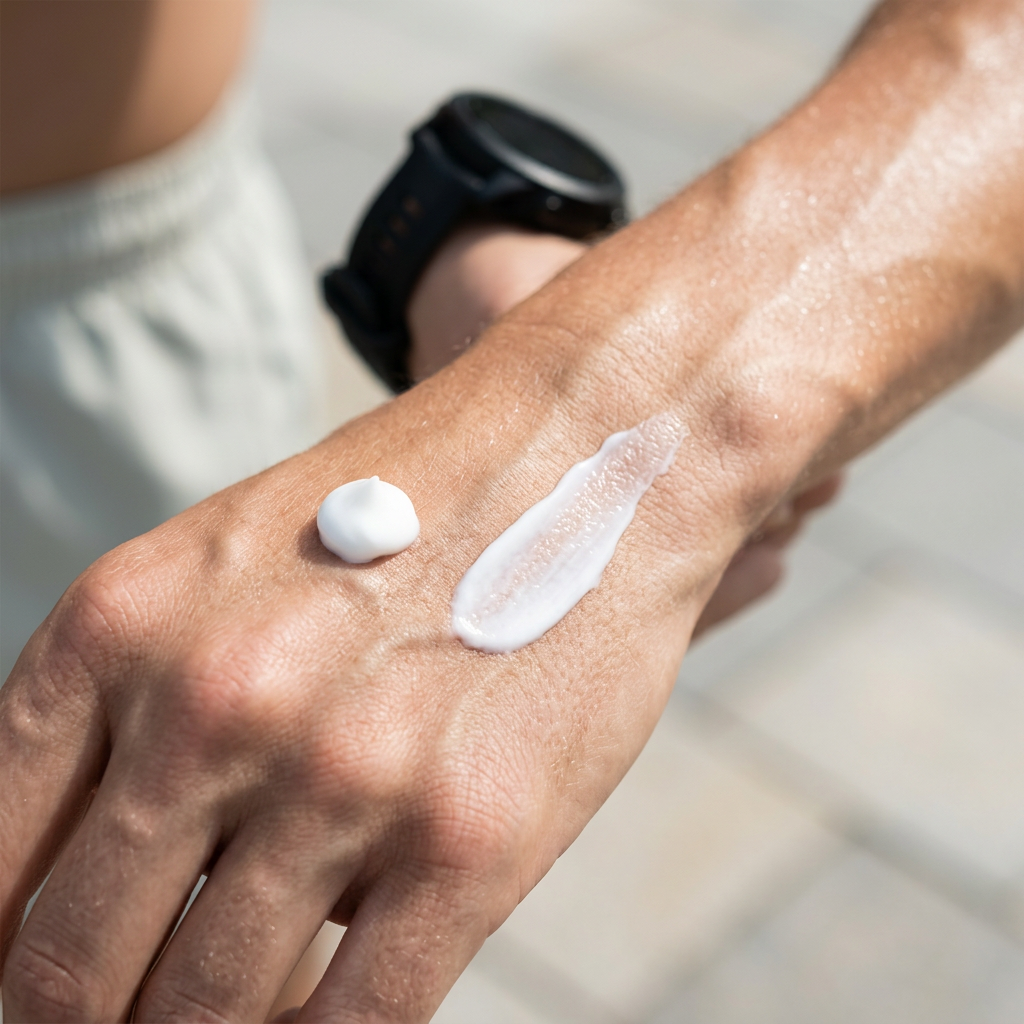
Anyone who has reached for a zinc-based sunscreen knows the trade-off. Zinc oxide is one of the most trusted UV filters in the world — broad-spectrum, stable, and a mainstay of Australian sun care — but it has a stubborn cosmetic flaw. On the skin it can leave a white or greyish film, and the deeper your skin tone, the more obvious that cast becomes.
A team at the University of California, Los Angeles thinks the answer is not a new chemical, but a new shape. In a study published in ACS Materials Letters and reported in February, the researchers describe zinc oxide particles engineered into microscopic four-armed structures called tetrapods. Blended into test sunscreen lotions, the tetrapod particles delivered a sun protection factor of about 30 — comparable to standard mineral formulas at the same concentration — while leaving far less of the tell-tale white residue.
Why zinc oxide turns white in the first place
The white cast is a physics problem before it is a formulation problem. Conventional zinc oxide for sunscreens is made by chemical processes that produce very small, roughly round nanoparticles. Individually, particles that small should be nearly invisible on skin. In practice, they do not stay individual: they clump together into larger aggregates, and those clumps scatter visible light — the wavelengths our eyes see — bouncing it back as that familiar chalky sheen.
Formulators have spent years working around this with coatings, tints and dispersing agents. The UCLA approach attacks the clumping itself.
The tetrapod particles are made using a patented high-temperature flame process — essentially growing the zinc oxide in a flame rather than precipitating it from a chemical solution — which yields much larger particles with four slender arms radiating from a central core, a little like a caltrop or a jack from the children's game. Those arms turn out to be the whole trick. First author AJ Addae, a doctoral candidate in chemical biology at UCLA and a cosmetic chemist, explained that the arms act as standoffs, so the particles form loose, porous networks instead of collapsing into dense clumps. "They can't pack tightly and aggregate, so they stay evenly distributed in the sunscreen," Addae said.
Evenly spread particles scatter visible light more softly. In laboratory measurements and controlled applications on skin, the tetrapod lotions read warmer and closer to natural skin tones than conventional zinc formulas — without any masking pigments or special particle coatings. The project began personally for Addae, who was frustrated by how mineral sunscreen looked on her own skin, and the first test batches already showed a visible difference.
The protection held up
A cosmetic win would mean little if the sun protection suffered, and this is where the results are most encouraging. Tested at the same concentration as regular zinc oxide, the tetrapod formulations achieved an SPF of about 30 and blocked across both UVB — the wavelengths chiefly responsible for sunburn and much of the skin cancer risk — and UVA, which drives longer-term skin damage. The lotions were also more stable over time, with fewer signs of separating or thickening than the conventional comparison formulas.
That combination — equivalent protection, better aesthetics, improved shelf stability — is rare in sunscreen science, where cosmetic upgrades usually cost something in performance.
Why this matters beyond vanity
It would be easy to file this under cosmetic niceties. The researchers argue otherwise, and the logic is hard to dispute: sunscreen only works if people wear it, and the white cast is one of the best-documented reasons people — particularly people with darker skin tones — skip mineral sunscreens or use too little.
That gap has real consequences. Melanoma is less common in people with darker skin, but when it does occur it is often diagnosed later, with poorer outcomes. Senior author Paul S. Weiss, a distinguished professor at UCLA, put it plainly: "This isn't just about cosmetics." If a better-looking sunscreen leads to more consistent use, he said, it could have real implications for skin cancer prevention.
Addae framed the goal the same way: "The best sunscreen is the one people will actually use."
For an Australian readership, that argument lands close to home. This country has among the highest skin cancer rates in the world, and mineral filters like zinc oxide remain popular with people who prefer them for sensitive skin or environmental reasons. Any advance that removes a reason not to reapply is worth watching.
The necessary caveats
This is laboratory-stage research, not a product. The tetrapod sunscreens exist as test formulations; you will not find them on a pharmacy shelf here or anywhere else yet. The UCLA team is now working with dermatology colleagues, including the UCLA Health Skin of Color Clinic, to study how the particles interact with the skin's microbiome and to move the work towards real-world use. In Australia, sunscreens are regulated as therapeutic goods, so any commercial product built on a new particle form would also need to clear the TGA's requirements before sale — a process that takes time.
None of this changes today's advice. Existing sunscreens — mineral and chemical alike — work, and the familiar zinc formulas remain excellent protection even if they demand a moment's extra rubbing in. What the tetrapod work offers is a credible path to mineral sunscreen that looks as good as it protects, achieved not with new chemistry but with clever geometry. In a category where the biggest barrier to protection is often simply whether people like wearing the product, that is a genuinely meaningful piece of science.
Sources
- UCLA Newsroom — Mineral sunscreen that reduces white cast developed by UCLA researchers
- Phys.org — New mineral sunscreen reduces white cast by using tetrapod-shaped zinc oxide
- SciTechDaily — UCLA Scientists Rethink Sunscreen To Eliminate the Dreaded White Cast
- ACS Materials Letters — Flame-Synthesized Zinc Oxide Tetrapods for Photoprotection in Sunscreen Formulations