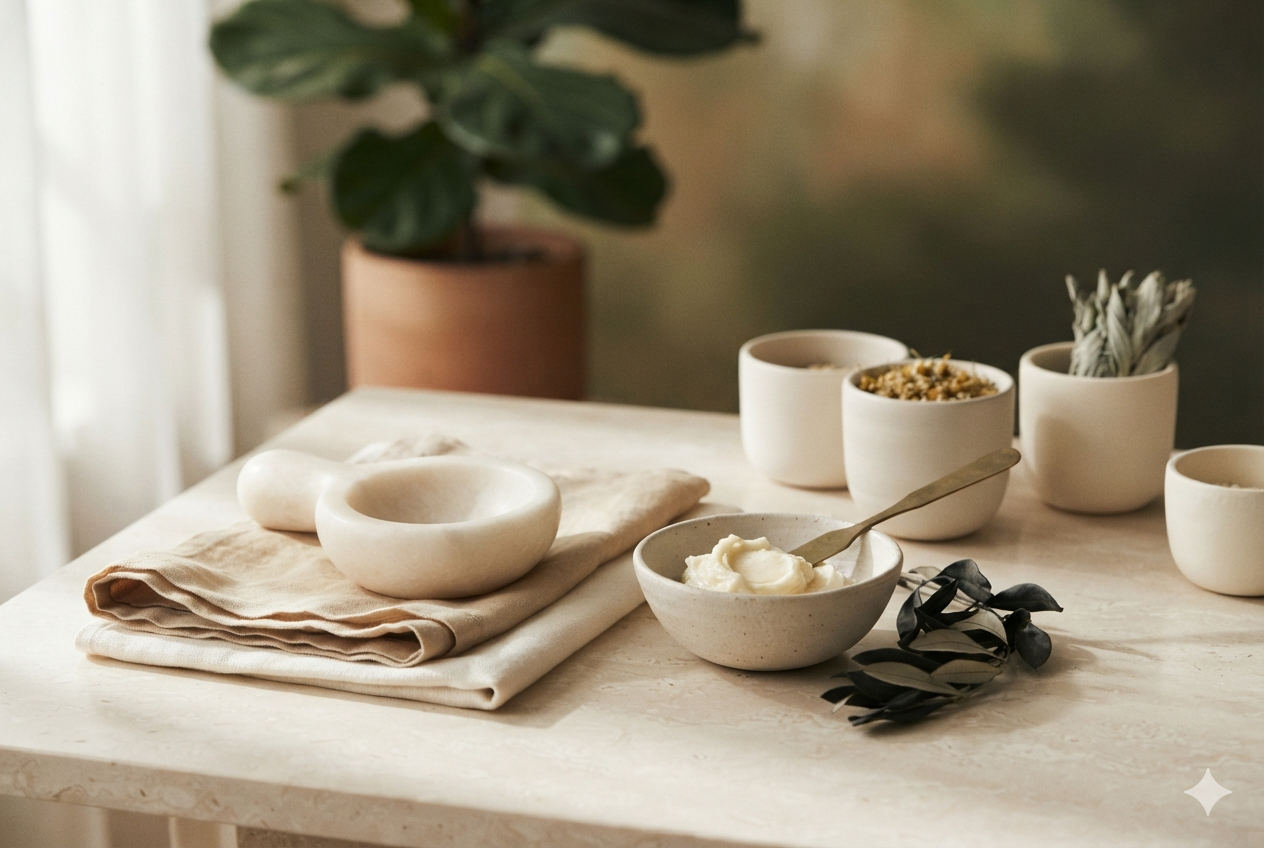
If you've scrolled past a jar of creamy white balm captioned "one ingredient, that's it", you've met tallow skincare. It is rendered beef fat, sold as a moisturiser, and it has become one of the most talked-about ingredients in beauty since 2024.
The reaction it provokes tends to be extreme. People either find the idea of cow fat on their face faintly horrifying, or they treat it as the antidote to a shelf full of unpronounceable synthetics. Neither reaction tells you much. What follows is the plain version: what the stuff is, why it behaves the way it does on skin, and who it genuinely suits.
What is tallow, and how is it rendered?
Tallow is fat from cattle that has been melted, strained and allowed to set. Cleveland Clinic describes it simply as fat from around a cow's kidneys and organs, melted and purified until it turns into a solid white substance with roughly the consistency of shortening.
The starting material is usually suet, the firm fat that sits around the kidneys. Rendering is the process of separating pure fat from the connective tissue, water and protein it comes packed with. Producers do this in one of two ways. Dry rendering means heating the fat gently on its own until it liquefies, then straining out the solids. Wet rendering means simmering the fat with water, often with salt added, so impurities settle out and the clean fat floats to the top to be skimmed and cooled. Wet rendering takes longer but tends to yield a paler, near-odourless fat, which is why most skincare-grade tallow is made that way.
That's the whole manufacturing story. There is no chemistry set involved, which is a large part of the appeal — and, as we'll get to, part of the problem when it comes to consistency between jars.
Why tallow skincare works the way it does
The reason anyone thought to put beef fat on skin is that it resembles what skin already makes.
Your skin's own oil, sebum, is built largely from a handful of fatty acids. So is tallow. It is dominated by oleic, palmitic and stearic acids, with some linoleic acid alongside them — the same fats found naturally in the skin barrier, as George Washington University dermatology chair Adam Friedman noted to National Geographic. Advocates call this "biocompatibility": the argument that tallow is closer to your own lipids than most lab-formulated creams.
Functionally, though, tallow is doing something quite ordinary. It is an occlusive. It sits on the surface, forms a physical seal, and slows the rate at which water evaporates out of the skin. That puts it in the same broad family as lanolin — the fat from sheep's wool that has been in pharmacy moisturisers for a century — and petrolatum. Occlusives don't add water to the skin. They stop the water already there from leaving.
Tallow also contains trace amounts of the fat-soluble vitamins A, D, E and K, which feature heavily in product marketing. How much of them actually crosses into skin, and whether that quantity does anything measurable, is not established.
A very old ingredient, newly rediscovered
None of this is new. Animal fat was the default skin salve for most of human history, in Egypt, Greece and Rome among many other places, simply because it was the emollient people had. It only fell out of fashion in the twentieth century when petroleum-derived and plant-derived alternatives became cheaper, more stable and easier to standardise.
The revival is a social media story. Tallow surfaced on TikTok around 2023 and 2024 and spread fast. Toronto dermatologist Geeta Yadav described the trend to National Geographic as the convergence of clean beauty with adjacent internet movements, including the carnivore diet — a broader appetite for single-ingredient, minimally processed products. It also rides on suspicion of mainstream cosmetics, which is worth naming honestly: for a lot of buyers, "I know exactly what's in this" is the actual selling point, not any specific benefit.
One claim to treat carefully is the appeal to ancient authority. When National Geographic asked Lixing Lao, a professor at the Virginia University of Integrative Medicine, about assertions that tallow has roots in traditional Chinese medicine, he found little evidence for it. Long use is not the same as documented use, and neither is proof of effect.
What tallow does well — and who should be careful
Here is the honest summary. Tallow is a competent occlusive moisturiser. On genuinely dry skin — cracked hands, elbows, heels, shins in winter — it does what a heavy balm does, and people who like it are not imagining the softness.
What it does not do is anything beyond that which has been demonstrated in humans. A 2024 scoping review in Cureus remains the most thorough look at the question, and it found the evidence limited and largely indirect: 19 studies met inclusion criteria, most of them animal or laboratory work rather than trials on people, and the authors concluded there are significant research gaps in how tallow can be used on human skin. There are no randomised controlled trials comparing it against an established moisturiser.
Dermatologists are correspondingly measured. Cleveland Clinic dermatology resident Angela Wei put it bluntly: "There's no evidence that shows beef tallow has any additional benefits for your skin beyond being a natural moisturizer." E. Victor Ross, director of laser and cosmetic dermatology at Scripps Clinic Carmel Valley, allows that "for people with really dry skin and no history of breakouts, a small amount may be tolerated" — but adds that "tallow can clog pores in some people. That makes it a poor choice for those with acne-prone or oily skin."
That is the main fit consideration. Tallow is thick and rated comedogenic, and dermatologists quoted across US coverage consistently flag acne-prone, oily, rosacea-prone and seborrhoeic skin as the groups most likely to react badly. Louisiana dermatologist Samantha Karlin also cautions that "natural" ingredients are perfectly capable of causing allergic contact dermatitis. Patch test on your inner forearm for a few days before it goes anywhere near your face, and start on the body rather than the face if you're unsure.
Two last practical notes. Because tallow products are largely unregulated and unstandardised, jars differ in purity and processing, so a good experience with one doesn't transfer to the next. And tallow offers no UV protection whatsoever. It is a moisturiser, not a sunscreen, and it should never displace one — particularly under an Australian sun.
Sources
- Cleveland Clinic — Is Beef Tallow Good for Your Skin?
- National Geographic — Beef tallow as skin care? Experts explain what's truth—and myth
- Cureus — Tallow, Rendered Animal Fat, and Its Biocompatibility With Skin: A Scoping Review
- Scripps Health — Beef Tallow in Skin Care: Safety, Benefits and Risks
- Healthline — Beef Tallow for Skin