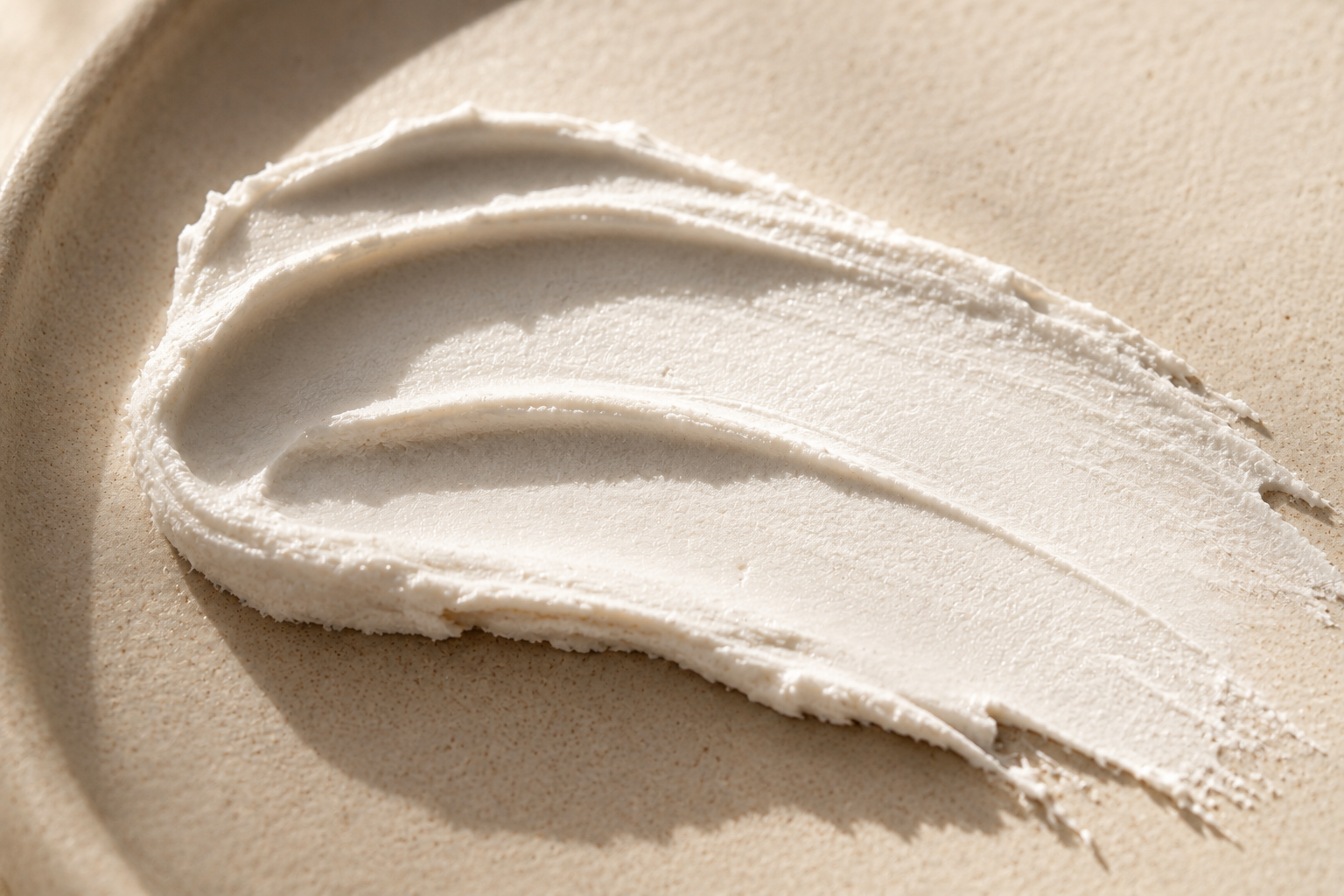
Zinc oxide is the closest thing sunscreen has to an old friend. It has been used on skin for well over a century, sits in an enormous share of Australian formulas, and carries a reputation for being both gentle and thorough.
Most of that reputation survives scrutiny. The explanation attached to it — printed on packaging, repeated in shop aisles — does not. Zinc oxide does not work the way almost everyone says it does.
What zinc oxide actually is
Zinc oxide is an inorganic compound, a white powder in its raw state, used industrially in everything from rubber manufacturing to nappy rash cream. In sunscreen it is one of two mineral UV filters in common use, the other being titanium dioxide.
The industry shorthand splits filters into "mineral" or "physical" versus "chemical" or "organic". The dividing line is real chemistry — inorganic metal oxides on one side, carbon-based molecules on the other — but the labels carry baggage they do not deserve. Both categories are manufactured chemicals.
Particle size is the variable that matters most in practice. Zinc oxide can be milled coarse or engineered down to the nanoscale, and modern formulas often use coated nanoparticles for a lighter feel.
How it works: absorption, not a mirror
The standard story is that mineral filters sit on the skin and bounce UV away like a mirror, while chemical filters soak it up. It is a tidy image. It is also wrong, and the correction is well documented.
A 2016 paper in Photodermatology, Photoimmunology and Photomedicine measured how much UV metal oxide sunscreens actually reflect. Across the UV range the answer was roughly 4 to 5 per cent — less than SPF 2. If reflection were the mechanism, zinc oxide would be close to useless.
What is really happening is semiconductor physics. Zinc oxide has a band gap in the ultraviolet region, so UV photons carry enough energy to excite electrons across it. The photon is absorbed, its energy dissipates largely as low-grade heat, and the radiation never reaches deeper skin. That is the same broad principle organic filters work on, reached by a different route.
The myth persists partly because zinc oxide is genuinely reflective — at visible wavelengths. Below the band gap energy, in visible light, the particles reflect strongly, which is why the powder looks white. Our intuition about what we can see gets projected onto the part of the spectrum we cannot.
Two consequences follow. An even, generous layer matters as much for mineral sunscreen as any other, because absorption needs filter where the light lands. And the mineral-versus-chemical debate is narrower than usually presented: both families absorb UV.
Broad-spectrum coverage and where regulators stand
Zinc oxide's real distinction is range. It absorbs across UVB, UVA2 and into the long UVA1 wavelengths — an unusually wide window for one ingredient, where comparable coverage from organic filters usually needs a combination.
That matters because UVA drives much of the photoageing that SPF alone does not describe. SPF is essentially a sunburn measure, and sunburn is mostly UVB. In Australia the gap is closed by the standard: AS/NZS 2604 requires a critical wavelength above 370nm before a product may claim broad spectrum, so a compliant Australian sunscreen has been tested for UVA performance, whatever filters it uses.
Regulatory status is about as settled as sunscreen chemistry gets:
- Australia. Primary sunscreens are therapeutic goods regulated by the TGA, listed on the ARTG and tested to AS/NZS 2604:2021, mandatory for new listings since July 2024. Zinc oxide is an established permitted active.
- United States. In its 2019 proposed rule the FDA identified only two of the sixteen filters under review as generally recognised as safe and effective — zinc oxide and titanium dioxide — at up to 25 per cent. Twelve others were flagged as needing more safety data.
- European Union. Zinc oxide is permitted in nano and non-nano form at up to 25 per cent, with one carve-out: not in sprayable products, because the safety assessment could not rule out risk from inhaling the particles.
On nanoparticles, the TGA maintains a standing literature review and its conclusion has held. Across in vitro and in vivo studies, zinc oxide and titanium dioxide nanoparticles do not meaningfully penetrate beyond the stratum corneum — the dead outer layer of skin — making systemic absorption, and so systemic toxicity, highly unlikely when sunscreens are used as directed.
Sensitive skin, white cast and the myths worth retiring
The sensitive-skin reputation is the strongest of zinc oxide's soft claims, and worth being precise about. Zinc oxide is a poor allergen: reports of allergic contact dermatitis to it are rare, and clinicians routinely reach for mineral formulas for rosacea-prone, post-procedure or paediatric skin. Honest caveat — much of that preference rests on clinical convention and low complaint rates rather than head-to-head trials against modern organic filters. And plenty of irritation blamed on a filter actually traces to a product's fragrance, preservatives or texture.
Then there is the white cast: the chalky or grey film zinc leaves, more visible the deeper your skin tone. It follows directly from the visible-light reflection described above, and worsens when nanoparticles clump instead of dispersing evenly. This is a real trade-off, and for many people it decides whether sunscreen gets worn at all — which makes it a protection issue, not a vanity one. Formulators have chipped away at it with tints and coatings, and research is now targeting the particle behaviour itself: a UCLA team recently reported zinc oxide grown into four-armed "tetrapod" shapes that resist clumping and read closer to natural skin tones while holding around SPF 30 in testing.
Two other claims deserve retiring. Zinc oxide is not "chemical-free" — it is a chemical compound. And a higher zinc percentage does not reliably mean higher SPF: dispersion, particle size and the surrounding formula matter at least as much. Read the tested SPF, not the ingredient percentage.
One last point, flagged as thin evidence. Laboratory work has found that formulas combining zinc oxide with certain small-molecule organic filters can undergo photochemistry that degrades those filters and lowers UVA protection. That is a finding about specific combinations, not a verdict on hybrid sunscreens, and it is a formulation problem for manufacturers rather than a reason to doubt a product that has passed standard testing.
None of which changes the practical advice. The most protective sunscreen is the one you will apply properly, in enough quantity, and reapply. If a zinc oxide formula suits your skin and you will keep using it, it is an excellent choice — and among the best-evidenced filters on the shelf.
### Looking for zinc oxide and tallow together?
Koa Shore combines zinc and tallow in daily skincare—evidence-backed protection paired with nourishing hydration. No sunscreen marketing, just the ingredients that work.
Sources
- Photodermatology, Photoimmunology and Photomedicine — Metal oxide sunscreens protect skin by absorption, not by reflection or scattering
- PubMed — Metal oxide sunscreens protect skin by absorption, not by reflection or scattering
- Therapeutic Goods Administration — Sunscreen regulation in Australia
- Therapeutic Goods Administration — Proposed adoption of the Australian/New Zealand sunscreen standard AS/NZS 2604:2021
- Therapeutic Goods Administration — Literature review on the safety of titanium dioxide and zinc oxide nanoparticles in sunscreens
- Federal Register — Sunscreen Drug Products for Over-the-Counter Human Use (2019 proposed rule)
- US Food and Drug Administration — Fact sheet: FDA proposed rule on sunscreen drug products
- EUR-Lex — Commission Regulation (EU) 2016/621 amending Annex VI to Regulation (EC) No 1223/2009
- PMC — Zinc oxide-induced changes to sunscreen ingredient efficacy and toxicity under UV irradiation
- ACS Materials Letters — Flame-synthesised zinc oxide tetrapods for photoprotection in sunscreen formulations
- UCLA Newsroom — Mineral sunscreen that reduces white cast developed by UCLA researchers