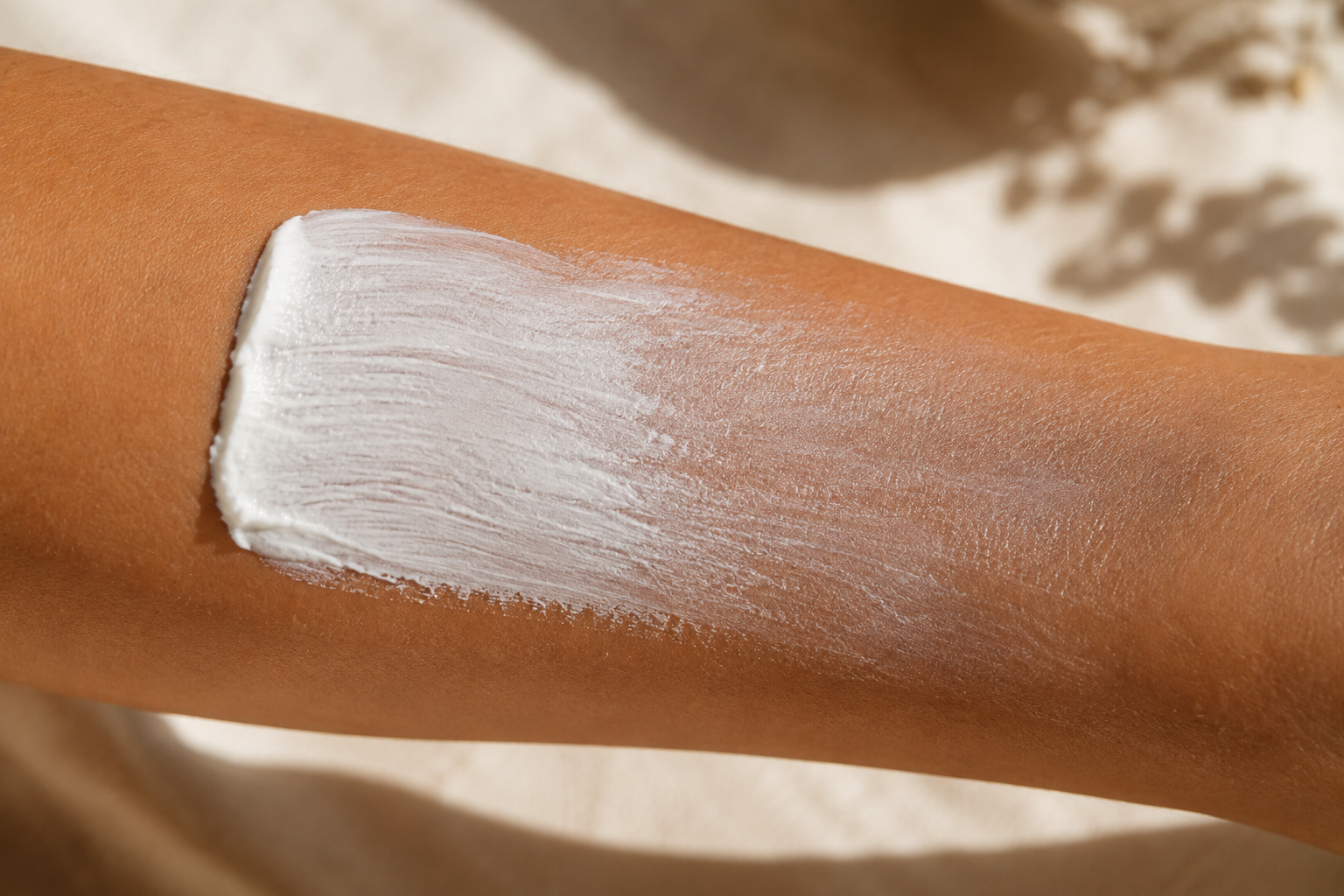
Almost everyone who has tried a mineral sunscreen has had the same moment: the product goes on, you look up, and a stranger with a grey-lilac face looks back. Zinc sunscreen white cast is the single most common reason people give for abandoning mineral formulas, and in a recent study of mineral sunscreen appearance, 85 per cent of volunteers said they had concerns about white cast when applying sunscreen. It is worth understanding what causes it, because the fix is a formulation problem with real progress behind it — not a personal failure of blending technique.
It is scattering, not staining
Zinc oxide does not dye your skin white. It scatters visible light back at the viewer, and it does that because of a mismatch in refractive index. Zinc oxide's refractive index sits near 2.0, while the oils, water and emulsifiers around it sit closer to 1.4 or 1.5. The bigger that gap, the more strongly each particle bends and bounces light. Titanium dioxide, with a higher refractive index still, is chalkier again, which is why zinc-dominant formulas tend to look better on skin.
Size then decides which light gets scattered. Particles a couple of hundred nanometres across — roughly comparable to the wavelength of visible light — are extremely efficient at scattering it. Grind particles well below that and they keep attenuating ultraviolet while letting most visible light through, which is what makes a modern mineral sunscreen look nearly clear in the tube.
The catch is that particles rarely stay separate. As the UCLA team behind recent work on the problem describes it, conventional round zinc oxide nanoparticles clump together in the formula, destabilising it and scattering visible light — an effect especially noticeable on darker skin tones. Aggregates behave optically like the large particles you were trying to avoid. That is why two sunscreens with identical zinc percentages on the label can look completely different on skin.
Concentration matters too, and it has now been measured. Researchers publishing in PLOS One built a standardised scoring method for white cast, using a colour sensor to track the L\* (lightness) value of skin before and after application across 13 volunteers spanning Fitzpatrick types II to VI, and grouping skin tones by individual typology angle rather than by self-report alone. Lightness rose sharply and consistently with zinc oxide content. Their working thresholds: around 5 per cent produced a reasonable cast, 10 to about 15 per cent sat at the borderline, and 20 to 30 per cent was rated unacceptable. Tolerance also depended on where the product went — a similar share of volunteers accepted 10 per cent on the face as were happy with 20 to 30 per cent on the body. Notably, at high concentrations even lighter skin tones rated the cast unacceptable, so this is not solely a deeper-skin issue, even though that is where it bites hardest.
What formulators can do about it
Four levers do most of the work. The first is particle size: milling zinc oxide well under 0.2 micrometres reduces visible-light scattering and lifts transparency. The second is surface treatment — coating particles so they wet properly, disperse evenly and resist re-clumping in the emulsion, which is as much about keeping them apart as about making them small. The third is the surrounding formula itself: choosing oils and film formers that narrow the refractive-index gap between particle and vehicle reduces scattering without touching the zinc at all. The fourth is pigment — iron oxide tints, which visually neutralise the grey and, as dermatology clinicians often note, add some protection against visible light in the bargain.
None of this is free. Every gain in transparency has to be defended against the SPF the formula is being sold on, and against stability, so mineral sunscreens remain genuinely harder to formulate than chemical ones.
What helps at the mirror
Advice here is largely practitioner experience rather than trial evidence, so treat it as such. Speaking to Yahoo's beauty desk, dermatology physician associate Paula Brezavseck recommended patting sunscreen into skin rather than rubbing it in, using a makeup brush or sponge for application, and warming heavier products in the palm first so they spread more evenly. She favours zinc-based formulas over titanium dioxide, which she describes as tending to be chalkier, and prefers tinted mineral sunscreens because the iron oxides blend more seamlessly.
Other commonly repeated tips — applying over a moisturiser or onto slightly damp skin, building coverage in two thin passes rather than one thick one, and giving the film a few minutes to set before makeup — are consistent with the physics, since they help disperse particles rather than leaving them piled in clumps.
One caveat matters more than all of them: do not solve white cast by using less. Sunscreen SPF is measured at a set application density, and under-applying reduces real-world protection. If a formula only looks acceptable when you skimp, it is the wrong formula for you, not the wrong amount.
Why this is a public health question
Appearance drives use. People with deeper skin tones are less likely to use sunscreen consistently and are more likely to be diagnosed with skin cancer at a later stage — and a product that reads as ashy or grey on the face is a product that stays in the drawer. Cosmetic elegance is not vanity in this context; it is compliance.
That is the framing behind the most interesting recent work. At UCLA, researchers led by Paul S. Weiss, with doctoral candidate AJ Addae as first author, used a high-temperature flame process to make zinc oxide particles shaped like four-armed tetrapods rather than spheres. The arms act as standoffs, so the particles cannot pack tightly and instead form open porous networks that stay evenly distributed. In their test formulas the result was better stability, less separation and thickening, a markedly reduced cast that read warmer and closer to natural skin tones without added pigments — and an SPF of around 30 at concentrations comparable to conventional mineral sunscreens. The work was published in ACS Materials Letters. "The best sunscreen is the one people will actually use," Addae said in UCLA's announcement. We have covered that research in more detail in tetrapod zinc oxide and the white cast problem.
It is laboratory-stage work, not something on a shelf, and SPF 30 is a starting point rather than a finish. But combined with standardised ways to measure cast across skin tones, it points at a future where choosing mineral no longer means choosing between protection and looking like yourself.
Sources
- UCLA Newsroom — Mineral sunscreen that reduces white cast developed by UCLA researchers
- UCLA Health — UCLA researchers develop mineral sunscreen that reduces white cast
- PLOS One — A standardized scoring method for measuring white cast of mineral sunscreens and improving user compliance across diverse skin tones
- Journal of the American Academy of Dermatology — Demonstrating the whitening effect of mineral sunscreens across multi-cultural skin tones01493-7/fulltext)
- Cosmetics & Toiletries — Micron-sized zinc oxide dispersion for transparent high SPF formula
- Yahoo — How to avoid a dreaded white sunscreen cast and still protect your skin, according to experts
- Cancer Council Australia — Fact sheet: Sunscreen